“Design used to be the seasoning you’d sprinkle on for taste. Now it’s the flour you need at the start of the recipe.’’

— John Maeda, Designer and Technologist
closeing x icon

Contact us

Please tell us a bit about your project idea and we’ll get back to you as soon as possible.
Tell us about your project idea
Thank you! Your submission has been received!
Oops! Something went wrong while submitting the form.
closeing x icon
Privacy Policy

This Privacy policy was published on March 1st, 2020.

GDPR compliance

At UX GIRL we are committed to protect and respect your privacy in compliance with EU - General Data Protection Regulation (GDPR) 2016/679, dated April 27th, 2016. This privacy statement explains when and why we collect personal information, how we use it, the conditions under which we may disclose it to others and how we keep it secure. This Privacy Policy applies to the use of our services, products and our sales, but also marketing and client contract fulfilment activities. It also applies to individuals seeking a job at UX GIRL.

About UX GIRL

UX GIRL is a design studio firm that specialises in research, strategy and design and offers clients software design services. Our company is headquartered in Warsaw, Poland and you can get in touch with us by writing to hello@uxgirl.com.

When we collect personal data about you
  • When you interact with us in person – through correspondence, by phone, by social media, or through our uxgirl.com (“Site”).
  • When we get personal information from other legitimate sources, such as third-party data aggregators, UX GIRL marketing partners, public sources or social networks. We only use this data if you have given your consent to them to share your personal data with others.
  • We may collect personal data if it is considered to be of legitimate interest and if this interest is not overridden by your privacy interests. We make sure an assessment is made, with an established mutual interest between you and UX GIRL.
  • When you are using our products.
Why we collect and use personal data

We collect and use personal data mainly to perform direct sales, direct marketing, and customer service. We also collect data about partners and persons seeking a job or working in our company. We may use your information for the following purposes:

  • Send you marketing communications which you have requested. These may include information about our services, products, events, activities, and promotions of our partners. This communication is subscription based and requires your consent.
  • Send you information about the services and products that you have purchased from us.
  • Perform direct sales activities in cases where legitimate and mutual interest is established.
  • Provide you content and venue details on a webinar or event you signed up for.
  • Reply to a ‘Contact me’ or other web forms you have completed on our Site (e.g., to download an ebook).
  • Follow up on incoming requests (client support, emails, chats, or phone calls).
  • Perform contractual obligations such as invoices, reminders, and similar. The contract may be with UX GIRL directly or with a UX GIRL partner.
  • Notify you of any disruptions to our services.
  • Contact you to conduct surveys about your opinion on our services and products.
  • When we do a business deal or negotiate a business deal, involving sale or transfer of all or a part of our business or assets. These deals can include any merger, financing, acquisition, or bankruptcy transaction or proceeding.
  • Process a job application.
  • To comply with laws.
  • To respond to lawful requests and legal process.
  • To protect the rights and property of UX GIRL, our agents, customers, and others. Includes enforcing our agreements, policies, and terms of use.
  • In an emergency. Includes protecting the safety of our employees, our customers, or any person.
Type of personal data collected

We collect your email, full name and company’s name, but in addition, we can also collect phone numbers. We may also collect feedback, comments and questions received from you in service-related communication and activities, such as meetings, phone calls, chats, documents, and emails.

If you apply for a job at UX GIRL, we collect the data you provide during the application process. UX GIRL does not collect or process any particular categories of personal data, such as unique public identifiers or sensitive personal data.

Information we collect automatically

We automatically log information about you and your computer. For example, when visiting uxgirl.com, we log ‎your computer operating system type,‎ browser type,‎ browser language,‎ pages you viewed,‎ how long you spent on a page,‎ access times,‎ internet protocol (IP) address and information about your actions on our Site.

The use of cookies and web beacons

We may log information using "cookies." Cookies are small data files stored on your hard drive by a website. Cookies help us make our Site and your visit better.

We may log information using digital images called web beacons on our Site or in our emails.

This information is used to make our Site work more efficiently, as well as to provide business and marketing information to the owners of the Site, and to gather such personal data as browser type and operating system, referring page, path through site, domain of ISP, etc. for the purposes of understanding how visitors use our Site. Cookies and similar technologies help us tailor our Site to your personal needs, as well as to detect and prevent security threats and abuse. If used alone, cookies and web beacons do not personally identify you.

How long we keep your data

We store personal data for as long as we find it necessary to fulfil the purpose for which the personal data was collected, while also considering our need to answer your queries or resolve possible problems. This helps us to comply with legal requirements under applicable laws, to attend to any legal claims/complaints, and for safeguarding purposes.

This means that we may retain your personal data for a reasonable period after your last interaction with us. When the personal data that we have collected is no longer required, we will delete it securely. We may process data for statistical purposes, but in such cases, data will be anonymised.

Your rights to your personal data

You have the following rights concerning your personal data:

  • The right to request a copy of your personal data that UX GIRL holds about you.
  • The right to request that UX GIRL correct your personal data if inaccurate or out of date.
  • The right to request that your personal data is deleted when it is no longer necessary for UX GIRL to retain such data.
  • The right to withdraw any consent to personal data processing at any time. For example, your consent to receive digital marketing messages. If you want to withdraw your consent for digital marketing messages, please make use of the link to manage your subscriptions included in our communication.
  • The right to request that UX GIRL provides you with your personal data.
  • The right to request a restriction on further data processing, in case there is a dispute about the accuracy or processing of your personal data.
  • The right to object to the processing of personal data, in case data processing has been based on legitimate interest and/or direct marketing.

Any query about your privacy rights should be sent to hello@uxgirl.com.

Hotjar’s privacy policy

We use Hotjar in order to better understand our users’ needs and to optimize this service and experience. Hotjar is a technology service that helps us better understand our users experience (e.g. how much time they spend on which pages, which links they choose to click, what users do and don’t like, etc.) and this enables us to build and maintain our service with user feedback. Hotjar uses cookies and other technologies to collect data on our users’ behavior and their devices (in particular device's IP address (captured and stored only in anonymized form), device screen size, device type (unique device identifiers), browser information, geographic location (country only), preferred language used to display our website). Hotjar stores this information in a pseudonymized user profile. Neither Hotjar nor we will ever use this information to identify individual users or to match it with further data on an individual user. For further details, please see Hotjar’s privacy policy by clicking on this link.

You can opt-out to the creation of a user profile, Hotjar’s storing of data about your usage of our site and Hotjar’s use of tracking cookies on other websites by following this opt-out link.

Sharethis’s privacy policy

We use Sharethis to enable our users to share our content on social media. Sharethis lets us collects information about the number of shares of our posts. For further details, please see Sharethis’s privacy policy by clicking on this link.

You can opt-out of Sharethis collecting data about you by following this opt-out link.

Changes to this Privacy Policy

UX GIRL reserves the right to amend this privacy policy at any time. The latest version will always be found on our Site. We encourage you to check this page occasionally to ensure that you are happy with any changes.

If we make changes that significantly alter our privacy practices, we will notify you by email or post a notice on our Site before the change takes effect.

Screenshot of a digital design or wireframing tool, displaying a full-length, detailed grayscale wireframe of a website homepage next to two simpler, faded wireframes. The interface shows 'Sitemap' and 'Wireframe' tabs, and an 'Ask AI' panel with options to 'Generate New Page' or 'Generate New Sitemap'.

Research & Insights

The Evolution of the Blinking Cursor: Navigating the Challenge of Multiple Cursors in Design

reading time  - clock - icon
WSTAW
Author picture

The digital environment is constantly changing. Design evolves and adapts to new needs and new users. However, some solutions do not go out of fashion. People from all generations know them and changing them could introduce chaos or at least frustration.

All of you know it very well and see it every day while typing on any of your devices. It helps you by indicating the spot for your future text and does follow new letters as you type. It also specifies the location in the text where you want to paste something that you previously copied. You might have seen it as an underscore or a block but usually, it takes the form of a blinking vertical line. As we found out while researching for this article - it also has a lot of names

  • caret
  • blinking cursor
  • text cursor
  • text insertion point

Where did the blinking cursor even come from?

In the last century, along with technological development, the possibility of creating and editing texts on the first computers appeared. However, writers struggled with the problem of the lack of a quick and intuitive possibility of changing or removing a selected fragment of the text.

Charles Kiesling was one of the engineers interested in advancing the capabilities of computers in the 1950s. He worked on improving the logic circuitry of computers such as the IBM 650. In 1967, Kiesling filed a patent for a new typing solution - a blinking cursor. However, this solution became widely known and used in 1977 with the premiere of Apple II and a year later with the premiere of the first commercially popular word processor WordStar.

Today, anyone who has had a computer in their hands at least once knows what a cursor means. Designers and developers working on products and adding new features can’t disregard  solutions users are already used to.

So what should we do if we need to point two spots at once?

We’ve recently asked ourselves this question for the first time. We came across a case that made us think about it while designing a tool similar to code creator. The user was supposed to add a few elements in the line, which together created a whole code. Each of the elements could have been selected from a code completion list that also had a search function. First caret: the user needed to be able to see the location of a new element added in the "code". Second caret: if the user wanted to search for an element, the caret must have appeared in the active textfield.

What now? Should we delete one cursor? Gray it out? How about leaving both of them and ignoring the problem? We’ve decided to check some popular apps - desktop and mobile and find out how they solve this problem.
Gmail on Mac - Adding emoji to a new email

One caret follows the text entered in the search box. The other indicates the place in the email where the selected emoji will appear. It's worth noticing that they are both blinking and have the same color.
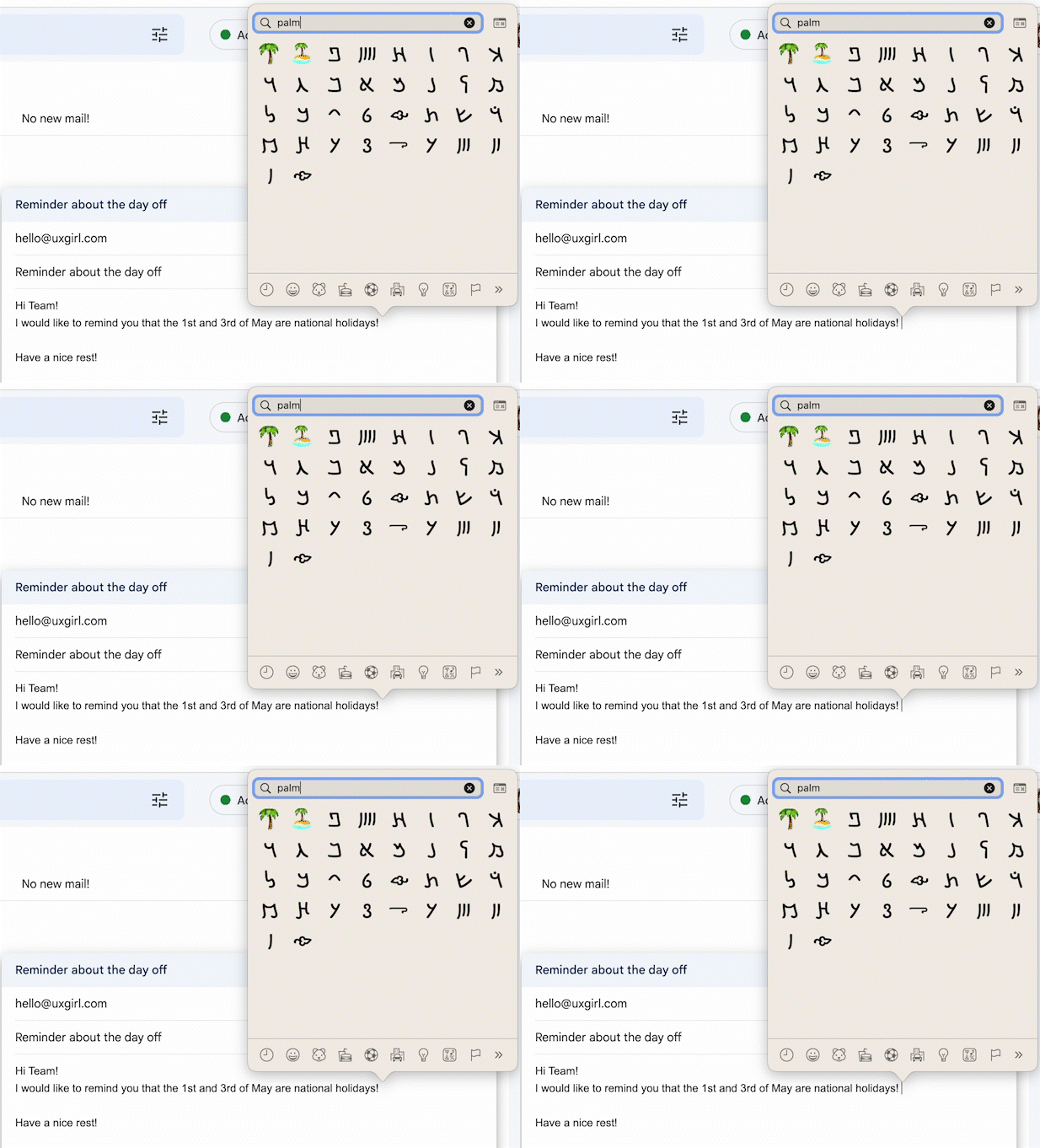
Screenshot of an email interface displaying a draft reminder about a holiday ('Reminder about the day off'). An emoji search window is overlaid on the upper right, showing the search query 'palm' and two resulting palm tree emojis, alongside several unrelated hand-drawn characters
Google Docs - Searching an element in the doc

In that case, the first cursor follows the text typed in the finder tool. The second one points to the last active text location. Both of the cursors have the same color, but just the one in the finder is blinking. The second cursor starts to blink again after closing the finder.

Screenshot of a Google Docs document titled 'Blogpost - Two Blinking Cursors,' showing a paragraph describing the behavior of two cursors when using the 'Find in document' search bar. The search bar is visible and active on the right side of the screen.
iOS Notes - Adding emoji to the note

iPhone users can experience a double text cursor creating a new note on their phones. The cursors are very different from each other - they have different colors and only the one in the search box is blinking.

Screenshot of the Apple Notes app in a light mode, displaying a 'Shopping list' with the items 'Doughnuts 🍩', 'Water 💧', and 'Milkshake 🥤'. The on-screen keyboard is active, showing the user searching for an emoji with the query 'milk' and the resulting milkshake emoji in the suggestions
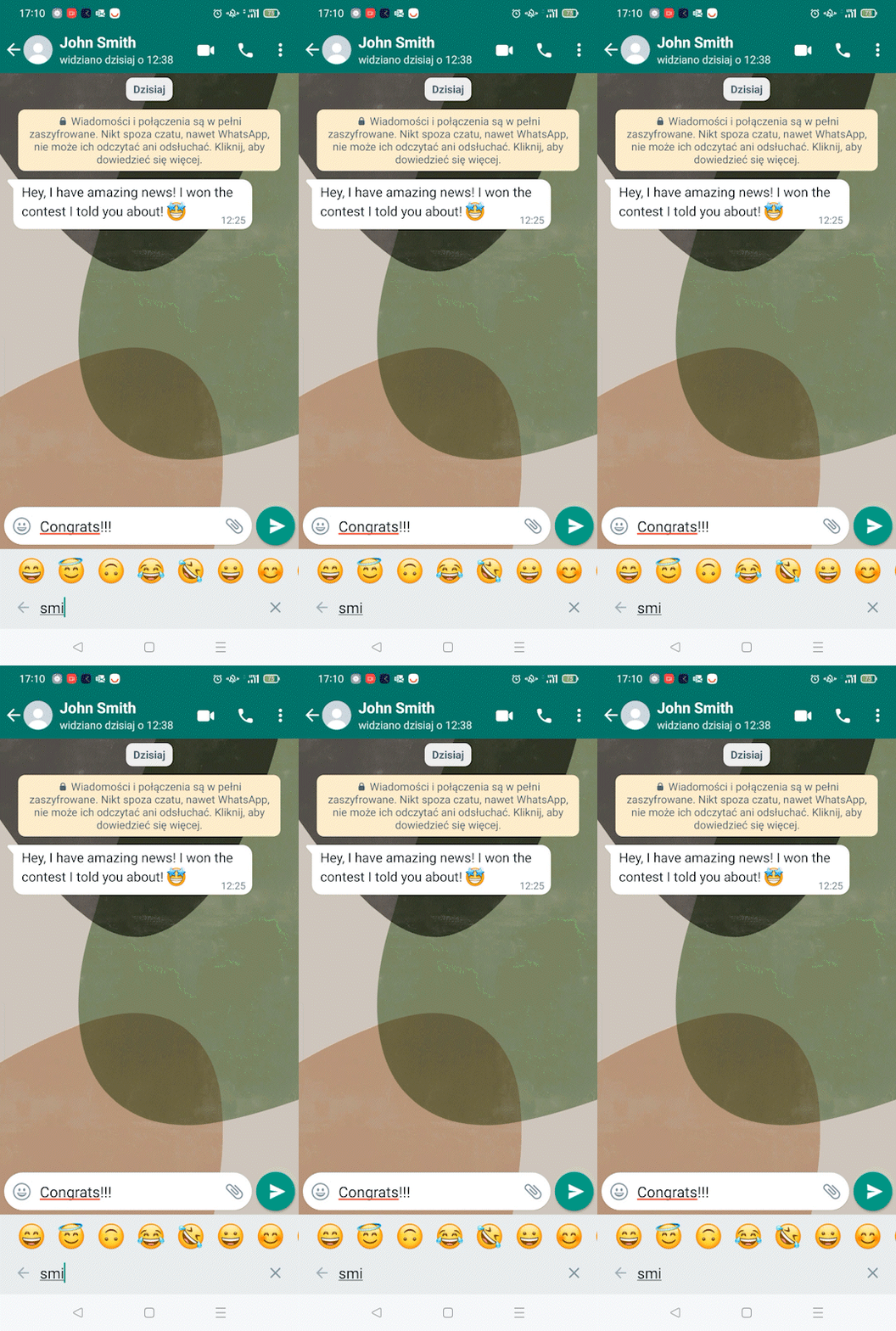
WhatsApp for Android - Adding emoji to the new message

In that case, we can see only one caret and it’s in a search box. The one in the textfield is invisible but the selected emoji appears in the place where a caret was active the last time.
A scenic photograph of rolling green mountains under a dramatic cloudy sky, partially overlaid with large, irregularly shaped purple masks, suggesting visual segmentation or masking technology is being applied to the clouds

Which one is the best?

After testing a few apps, it's time to summarize the pros and cons of each solution.

Visibility of both cursors at once

In our opinion, the user should always be able to see where the result of their action will appear. Making one of the carets invisible takes away some part of the user's control. So we stand for keeping both cursors visible to the user. What is important here is creating a hierarchy for them. So now let's take care of…

Colors

Let's pay attention to a good idea that appeared in one of the inspirations we found: the cursor that is not responsible for the main action on the screen is grayed out. To highlight the importance of the main cursor, we can also choose colors other than black. Blue for example will call attention to the active status of the textfield.

Blinking

Last but not least - blinking of the cursor. It is obvious that this function helps a lot in finding our current location in the text. But aren't two elements blinking on the screen too much? In our opinion, yes. In the case of a double cursor, we would definitely choose to animate only one of them, the main action one.

Conclusions

Adding a blinking cursor to the interfaces was undoubtedly necessary to facilitate many people's daily work. This invention has stood the test of time and is still widely used today. However, sometimes even the most reliable solutions need an adaptation to more complex features. Yet, as designers, we have to remember that if the user already knows the action of a component, we shouldn’t change it.

In our opinion, in this task, we should focus on designing the hierarchy of elements. We have the ability to work on the visibility, color, and movement of elements. This essential UX designer skill will keep the interface transparent and let the user stay in control. 

And you? How would you design a tool that requires two cursors? And as a user, have you noticed this problem in the apps you use?

A group of people seated around a long conference table in a bright meeting room, watching a presenter at the front who is pointing to a slide displayed on a wall-mounted screen.
reading time  - clock - icon
5 min

How AI Empowers UX Teams—Workshop with Silky Coders

Some time ago, UX GIRL had the pleasure of contributing to this shift by leading a hands-on workshop for the UX and UI design team at Silky Coders. The session was facilitated by our CEO, Magdalena Ostoja-Chyżyńska, and focused on practical, responsible, and creative applications of AI in the user experience design process - from early discovery to daily execution.

The energy in the room was undeniable. Silky Coders’ team brought openness, curiosity, and a hunger for meaningful innovation. Together, we dove deep into the new frontier of UX work - where human-centered design meets AI-supported workflows.

Logo consisting of a stylized, continuous-line ‘S’ symbol to the left of the text ‘Silky Coders’ in a clean, modern font.

AI in UX: Not a Threat, but a Tool

One of the key messages of the workshop was clear: AI is not here to replace designers - it’s here to support them. Rather than automating creativity, AI can serve as a strategic partner that:

  • Accelerates research in the discovery phase by summarizing large data sets, extracting patterns from user feedback, and supporting persona creation.
  • Supports ideation with concept generation tools, enabling faster brainstorming and prototyping.
  • Optimizes repetitive tasks such as UI variant testing, accessibility checks, and design documentation - giving designers more space for meaningful work.

According to McKinsey, teams that effectively integrate AI into their workflows can improve design delivery times by up to 30% and significantly reduce cognitive load during early research phases.

Balancing Innovation with Responsibility

An equally important topic explored during the session was responsible AI adoption. As powerful as these tools are, they come with ethical considerations: biased outputs, transparency concerns, and the risk of over-automation. The group discussed how to stay grounded in human-centered principles even as workflows evolve.

That means:

  • always validating AI-generated insights with real user data,
  • being transparent with stakeholders about AI’s role in the process,
  • ensuring diversity in training data and critically assessing the risks of bias in the tools used.

This human-first mindset is key to ensuring AI enhances - rather than dilutes - the quality of user experiences.

Key Takeaways for UX Teams Exploring AI

For those who couldn’t attend, here are three actionable ideas from the workshop that any design team can start applying:

  1. Start small, but start now. Test AI tools in low-risk areas like copy generation, image variations, or documentation support. Gradually integrate them into your design sprints.
  2. Create internal AI guidelines. Align your team on when, why, and how AI should be used. Define quality standards, review processes, and ethical boundaries.
  3. Treat AI as a design collaborator. Just like you might whiteboard with a teammate, you can brainstorm with AI. Use it not only to move faster, but also to explore what’s possible.

Looking Ahead

These workshops reminded us that the future of UX is not about man versus machine - it’s about collaboration between designers and technology. AI will continue to evolve, but the heart of UX will always be human insight, empathy, and creativity.

At UX GIRL, we’re proud to guide teams through this transition - not just by teaching tools, but by cultivating the mindset needed to design smarter, faster, and more ethically.

A big thank you to Silky Coders for your openness, energy, and curiosity. We can’t wait to see how your team transforms the knowledge from this session into even more impactful user experiences.

Until next time - let’s keep designing the future together.

A futuristic glass-walled meeting room with a glowing holographic interface surrounding a group of people seated at a conference table, overlaid with the text ‘OpenAI DevDay 2025.
reading time  - clock - icon
5 min

OpenAI DevDay 2025: What It Means for Business, Technology, and UX

Is AI becoming the new operating system for digital products? After OpenAI DevDay 2025, many tech leaders would say yes. This year’s announcements go far beyond model upgrades - they offer tools that could fundamentally change how companies design, build, and monetize experiences.

At UX GIRL, we’ve analyzed the most important updates and their real impact on product teams, UX designers, and business owners.

Key Announcements You Should Know

1. ChatGPT Apps (SDK preview)
Developers can now build and distribute apps directly inside ChatGPT, using a new SDK that enables more interactive and personalized experiences. This opens up a new layer of lightweight front-end experiences without building a full UI.

2. AgentKit - AI Production Agents
AgentKit helps teams build autonomous AI agents capable of completing tasks end-to-end. Think onboarding assistants, support bots, or even product recommendation engines.

3. GPT‑5 Pro and mini models
The new GPT‑5 Pro brings higher accuracy in complex scenarios. Meanwhile, lightweight versions of image and voice models (e.g., gpt-realtime-mini) reduce operational costs by up to 80%.

4. Sora 2 via API
Sora 2 introduces text-to-video generation capabilities via API, a game-changer for education, content creation, and personalized storytelling.

5. Codex - Expanded Integrations
Slack, SDK, and enterprise-grade governance tools make Codex even more practical for building collaborative, AI-powered productivity tools.

What It Means for Product, UX, and Tech Leaders

OpenAI’s DevDay updates are more than just developer features - they’re designed for real product impact. Here's why it matters:

  • ChatGPT Apps could act as alternative user interfaces for your product - fast to deploy, low maintenance.
  • AI agents allow teams to automate high-touch tasks with natural language interfaces.
  • Mini models lower the barrier to experimenting with AI at scale, without unpredictable infrastructure costs.

For UX teams, this means designing interactions between people and autonomous systems - where clarity, trust, and fallback mechanisms are critical.

Two Lists That Matter: Watchouts and Quick Wins

Top 5 Risks to Consider:

  1. Cost management - poorly scoped AI use can lead to soaring API bills.
  2. Compliance & safety - you’ll need moderation systems for AI-generated content.
  3. Unpredictable UX - AI outputs must feel consistent and transparent to users.
  4. AI skill gaps - many teams lack the cross-functional know-how to build responsibly.
  5. No validation pipelines - AI decisions still need testing like any other feature.

Quick Wins You Can Act On Today:

  • Audit product areas that could benefit from AI-powered assistance or automation.
  • Launch a small experiment using AgentKit - for example, a product suggestion agent.
  • Run usability tests for AI-based flows to ensure user comprehension and trust.
  • Bring UX, product, and AI engineers together into AI-focused sprints.

Final Thoughts: AI Is No Longer Just an Add-On

OpenAI DevDay 2025 marks a shift - we’re moving from playful experiments to strategic deployments. Businesses that treat AI as a core product function, not a gimmick, will lead the next wave of user experience innovation.

At UX GIRL, we help clients identify high-impact AI use cases, prototype responsibly, and test with real users. Whether you're in fintech, education, health, or e-commerce - this is the moment to think AI-first, user-always.

A group of four people in a modern office meeting room review mobile app wireframes displayed on a large screen, with laptops and sticky notes spread across the table.
reading time  - clock - icon
5 min

Designing Apps with OpenAI Apps SDK: UX Guidelines

Conversational AI has changed the rules of user experience. With OpenAI Apps SDK, teams can now create embedded applications that live directly inside ChatGPT - offering users seamless, intelligent, and contextual support.

But building these apps isn't just about writing smart code. It's about designing meaningful, intuitive interactions. That’s why OpenAI published official design guidelines - and why UX GIRL is here to help you translate them into real results.

What Are ChatGPT Apps and the Apps SDK?

ChatGPT apps are mini-tools that users can access directly in the ChatGPT interface. They allow users to perform tasks, analyze data, create documents, fetch information from external sources, and more - all within the flow of conversation.

The Apps SDK lets developers define these app interactions using JavaScript while maintaining full compatibility with the ChatGPT interface. But to deliver real value, apps need to feel intuitive - and that’s where UX comes in.

The Core Design Principles from OpenAI

OpenAI’s UX guidelines are built on six core principles. Here’s what they mean in practice, with insights from the UX GIRL team:

Clarity is key

Your app’s interface must clearly communicate what it does, how it works, and what users can expect. Avoid vague labels or overloaded screens. Guide users with simple language and clean layout.

Respect the user’s intent

Let users take the lead. Your app should support user goals, not hijack the conversation. Avoid aggressive prompts or forced flows.

Make progress visible

Users need feedback. Loading indicators, success confirmations, and microinteractions help users trust the process - especially in a conversational UI.

Minimize user effort

Reduce friction wherever possible. Use smart defaults, context-aware suggestions, and auto-filled values to streamline user input.

Be consistent

ChatGPT has a defined look and tone - follow it. Use system UI components and maintain consistency in voice, spacing, and layout.

Fail gracefully

Errors are inevitable. Design them to be informative and friendly. Offer users clear explanations and next steps without making them feel lost.

A collage of smartphone app screens showing ChatGPT assisting with tasks such as creating a pizza-themed playlist, recommending nearby pizzerias on a map, displaying restaurant details for ‘Brick & Basil,’ and generating music beats using a beat-making interface.

How Product Teams Can Apply These Guidelines

Following these principles doesn’t require a full UX overhaul - but it does require strategic thinking. Here are two practical ways your team can implement them:

1. UX-aligned development workflow:

  • Define realistic user conversations and app responses early.
  • Prototype conversations using mock UIs or prompt flows.
  • Test early and often - even with basic, Wizard-of-Oz style setups.
  • Build in real-time feedback elements (confirmation messages, visual states).

2. UX checklist for Product Owners:

  • Does the user always know what they can do next?
  • Are all actions and outcomes clearly explained?
  • Is app progress or system state visible?
  • Is tone and layout consistent with ChatGPT?
  • Do error messages guide users constructively?

The Unique UX Challenges of Designing Inside a Chat Interface

Unlike traditional apps, ChatGPT apps don't rely on menus, tabs, or visual hierarchies. Users interact through text - with fluid, nonlinear intent. This makes context one of the biggest UX challenges.

Small design gaps (e.g., unclear responses or missing context) can lead to confusion. That’s why good conversational design includes scenario testing, intelligent defaults, and visible state changes - even without a traditional UI.

Final Takeaways

Designing inside ChatGPT isn’t just about building functionality - it’s about earning user trust through clarity, empathy, and consistency.

At UX GIRL, we recommend:

  • Start with a small MVP to test a focused user goal.
  • Use OpenAI’s design principles as a design audit tool.
  • Involve UX early - especially for dialogue design and testing.
  • Don’t rely on AI to do everything. Guide the user intentionally.

Building with Apps SDK? Let UX GIRL help you design AI-powered experiences that convert, engage, and delight.

Begin your design adventure now!
Contact us